Time to Migrate from Heroku

Today is a sad day because last week a platform that we know, like, and trust made a surprising and disappointing announcement.
On February 6, 2026, Heroku published an update on the future of the platform . The announcement confirms what many in the community had suspected for a while: Heroku is transitioning to a “sustaining engineering model.”
In plain English, that means maintenance model: No new features, no new Enterprise Account contracts for new customers, and a focus on stability only.
If your Rails application runs on Heroku, this is the moment to start thinking about your next move. The platform is not disappearing overnight, but the direction is clear: Heroku’s best days are behind it and it’s time to migrate on your own terms to a provider that is not on maintenance mode.
Considering all this we are announcing a new productized service by FastRuby.io: Our Heroku Migration Service.
What “Sustaining Engineering” Really Means
Let’s read between the lines. “Sustaining engineering” is a corporate way of saying: we are keeping the lights on, but we’re not building anything new.
Enterprise Account contracts are no longer being offered to new customers. The platform will continue to function, but don’t expect improvements, new integrations, or competitive pricing updates.
The developer community has reacted strongly with a mix of nostalgia, sadness, and urgency.
Heroku pioneered git push deployments and fundamentally changed how we think about deploying applications. It made infrastructure accessible
to developers who did not want to manage servers. But the platform has been stagnating for years and this announcement makes it official.
I see this as the beginning of the end for a platform that once defined modern deployment. Whether that happens in one year or five, the trajectory is clear. The timeline is not.
Why You Should Start Planning Your Migration Now
Even though existing contracts will be honored, the writing is on the wall. Here’s why I think waiting is risky:
- No new features means the platform will fall further behind modern alternatives
- The longer you wait, the more complex the migration becomes: Dependencies grow, configurations drift, and institutional knowledge fades
- Teams that migrate proactively (on their own timeline) consistently do better than those that migrate under pressure
The best time to migrate is when you have the luxury of choosing your timeline and your target platform. That window is open now.
Where to Migrate: Modern Alternatives
The good news is that the ecosystem of Heroku alternatives has matured significantly.
In the past we have helped our clients migrate to these platforms:
Platform-as-a-Service (PaaS) Alternatives
These platforms offer a similar experience to Heroku: managed infrastructure, simple deployments, and minimal DevOps overhead.
They are the closest drop-in replacements for most Ruby and Rails applications.
- Render
- The closest experience to Heroku, with predictable pricing and a familiar developer workflow
- Fly.io
- Great performance with global edge deployment, ideal for latency-sensitive applications
- Railway
- Developer-friendly with fast setup, a strong choice for small-to-medium applications
- Hatchbox
- Built specifically for Ruby and Rails by Chris Oliver from GoRails, runs on top of DigitalOcean or Hetzner
- DigitalOcean (App Platform)
- Simple, GUI-based management for teams that want straightforward infrastructure
- Porter
- A platform built on top of your own cloud account (AWS, GCP, Azure), giving you Heroku-like simplicity with full infrastructure ownership
Enterprise Cloud Platforms
These are not PaaS solutions. They offer more flexibility and control, but they also require significantly more setup, maintenance, and infrastructure expertise.
Pricing can be steeper and less predictable than the PaaS alternatives above:
- AWS (ECS/Fargate)
- Enterprise-grade with the most flexibility, but comes with a steeper learning curve
- Google Cloud (Cloud Run)
- Fully managed containers with automatic scaling, strong for teams already in the Google ecosystem
- Microsoft Azure (App Service)
- A solid option for teams already invested in the Microsoft ecosystem
- Hetzner
- Affordable European hosting with excellent price-to-performance, a solid option for teams comfortable managing their own infrastructure
Many of these platforms work well with Kamal , the Docker-based deployment tool originally built for Rails.
Kamal offers zero-downtime deploys, rolling restarts, and accessory service management, which makes providers like Hetzner, DigitalOcean,
AWS, and Azure a lot more approachable for teams used to the simplicity of git push deploys on Heroku.
Unfortunately there is no magic replacement for Heroku. The best replacement will depend on your team’s skills, requirements, and migration budget.
The best choice depends on your application’s specific requirements, team size, budget, traffic patterns, and compliance needs.
That is why we start every engagement with a thorough analysis.
Our Heroku Migration Service
We’ve structured our migration service into clear phases so you know exactly what to expect at every step.

Phase 1: Analysis (~1 week)
We start by analyzing your entire Heroku environment: dynos, add-ons, database management systems, caching systems, background system, scheduled tasks, environment variables, and integrations.
We assess your application architecture, dependencies, and infrastructure requirements. Our analysis is flexible to your own goals. For example: If you are dead set on migrating to Render, we will take that into account before kickstarting our analysis spike.
The deliverable is a detailed action plan with estimates (best case and worst case, measured in dev/weeks) so you can make an informed decision before committing.
Phase 2: Client Approval
We present the plan, walk through our recommendations, and answer your questions. You approve the plan and the target platform before any migration work begins.
No surprises here. You stay in control.
Many of our clients have trusted us to deliver zero-downtime migrations in weeks, not months. If you want to have your team work on the migration plan, you can skip the next phases.
Phase 3: Building the New Environment
Think of this phase as our team creating a new staging environment that will eventually become your production environment.
Here are a few common steps for every Heroku migration:
- Set up the target infrastructure from scratch
- Migrate databases and data stores
- Configure CI/CD pipelines
- Replicate all services and integrations
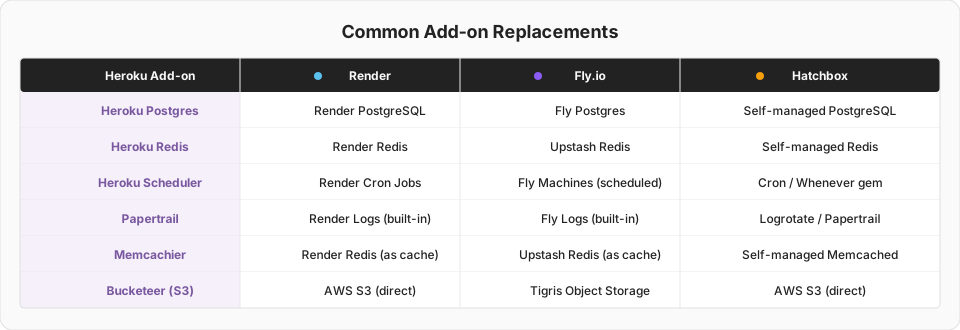
- Handle add-on replacements (Heroku Postgres to a managed database, Heroku Redis to managed Redis, and so on)
Phase 4: Validation and Cutover
We work with your team to confirm everything works as expected. This includes thorough functional, performance, and integration testing.
Once you approve, we coordinate DNS updates for a smooth cutover with minimal downtime.
Phase 5: Post-Migration Monitoring
After cutover, we monitor performance and watch for anomalies to catch anything that may have been missed. If issues come up, we respond quickly to get production back to 100%.
Phase 6: Ongoing Maintenance and Support (Optional)
After the migration stabilizes, we offer a small, fixed-cost monthly maintenance package. We monitor and improve performance, keep dependencies up to date, and make sure your application stays secure on its new platform.
This is totally optional and usually great for small businesses and startups with small engineering teams.
Why Top Engineering Teams Trust FastRuby.io
We have invested over 60,000 dev/hours migrating, supporting, upgrading, and optimizing Rails applications of all shapes and sizes.
Our clients range from one-person engineering teams to Fortune 500 companies with hundreds of engineers.
Our customers trust our deep Rails expertise will save them time and headaches on critical projects like a PaaS migration.
Whether it’s a version upgrade, a vendor transition, or a full platform migration, we bring a structured process and years of experience to every engagement.
Next Steps
One of the features that I will miss the most from Heroku is the one that allowed us to create review apps. Many years ago, we open sourced a project to manage review apps by adding labels to pull requests !
Change is hard, especially when you are running your own business, your product’s roadmap, and a dozen other priorities. We know this because most of our internal applications have been running on Heroku for years and now it’s one more thing we need to add to future sprints…
If your Rails application is on Heroku and you want to explore your options, we would love to help. These changes are hard and you need a vendor you can trust to deliver a zero-downtime migration.