SF Ruby '26: Ruby's Best Years Are Ahead

On November 10, I was in the audience at SFJAZZ when Irina Nazarova opened SF Ruby 2026 . Irina is the CEO of Evil Martians, and for the last three years she has been interviewing founders who are building new companies on Ruby and Rails.
A month ago I wrote about DHH’s Rails World keynote , and I ended that post wanting to hear more about the future of Rails from the people building on it.
Irina’s keynote was that talk.
She opened with a video message from Garry Tan, President and CEO of Y Combinator, who couldn’t make it in person. He said one line that Irina kept coming back to for the rest of the hour:
Ruby’s best years might be ahead of us.
I left the room agreeing with him. Here is why.
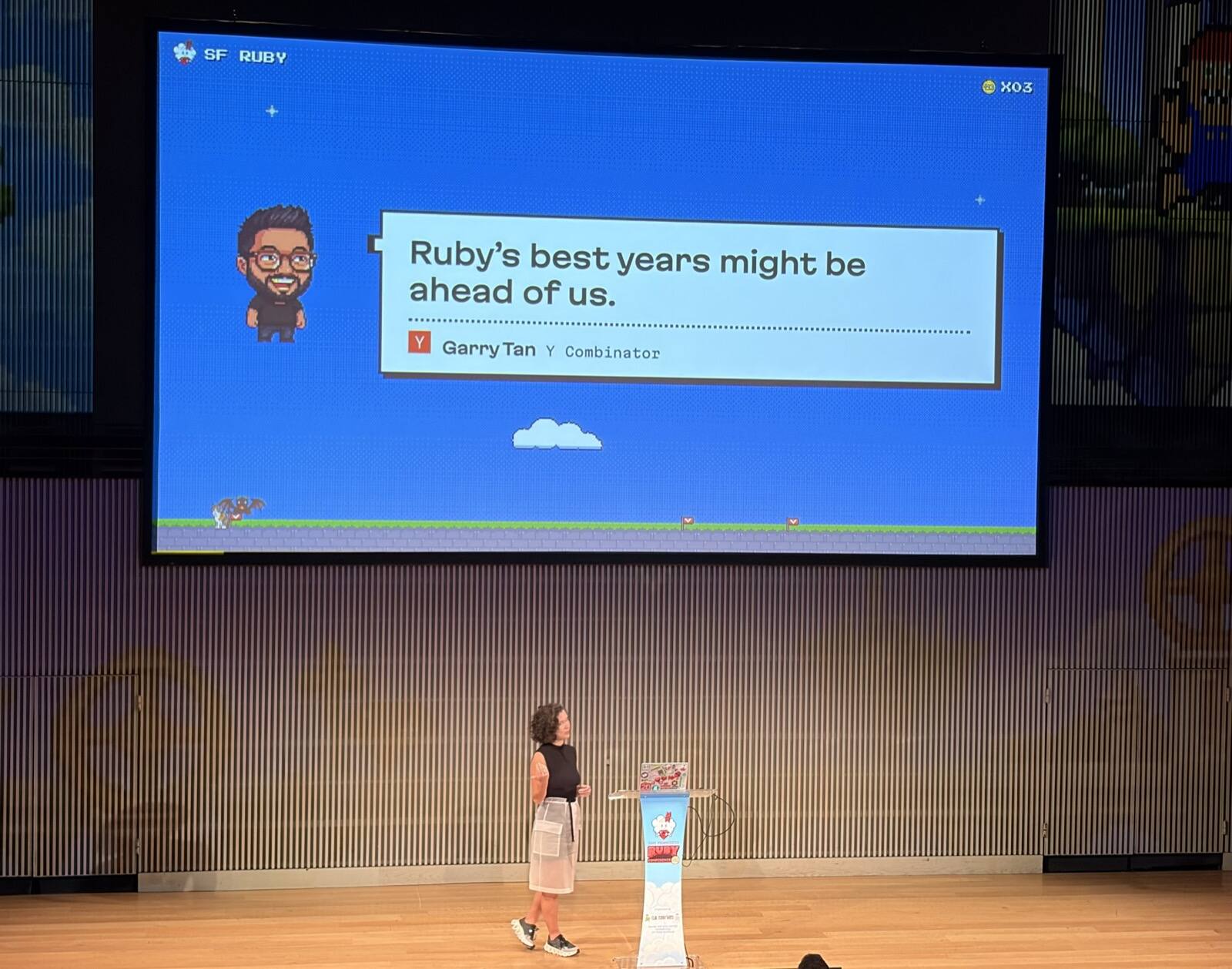
Convention over Configuration (Garry Tan)
Garry went through YC in 2008 and built Posterous on Rails. His point was that convention over configuration is why two people could ship a product used by millions, and that a whole generation of YC companies got built the same way.
Then he connected that to today. What makes a codebase easy for an agent to work in? It should be readable, consistent, and do things the same way every time.
That is what this community has been obsessed with for 20 years.
Rails conventions turned out to be an incredible gift to the models. Less to explain, less to guess, more that just works.
He said YC is now seeing teams of fewer than 20 people build companies that used to take hundreds.
His ask was simple: keep building, start the company, ship the side project, and teach the next person why beautiful code still matters, even when a robot helps write it.
I’m a big fan of that framing.
What founders say works
Irina asks every founder three questions: What works? What’s missing? And, since this year, what has changed with AI?
This edition drew on eight founders, and a few of their answers stuck with me.
Cole Robertson of Rebulk is running a Rails app on a tiny Jetson computer on a farm with no cell reception, connected over Starlink. It’s still Rails. He also said Rails has “the web primitives nailed down in a way no other framework has.”
Paul Cothenet of Tern thought they would need Python to build AI workflows in production.
They didn’t.
His line was that Rails is still “a cheat code” for building AI features.
Kieran Klaassen is building Cora, an email product, as a single-person team competing with much larger companies. He said that is only possible because of Rails.
Carmine Paolino, the author of RubyLLM , is reading more code than ever. I don’t know about you, but if I’m going to read a lot of code, I still prefer to read Ruby code.
That last point is the one I keep repeating. We may write less code by hand, but someone still has to read it, review it, and decide whether it’s good.
Readability matters more in the agentic era, not less.
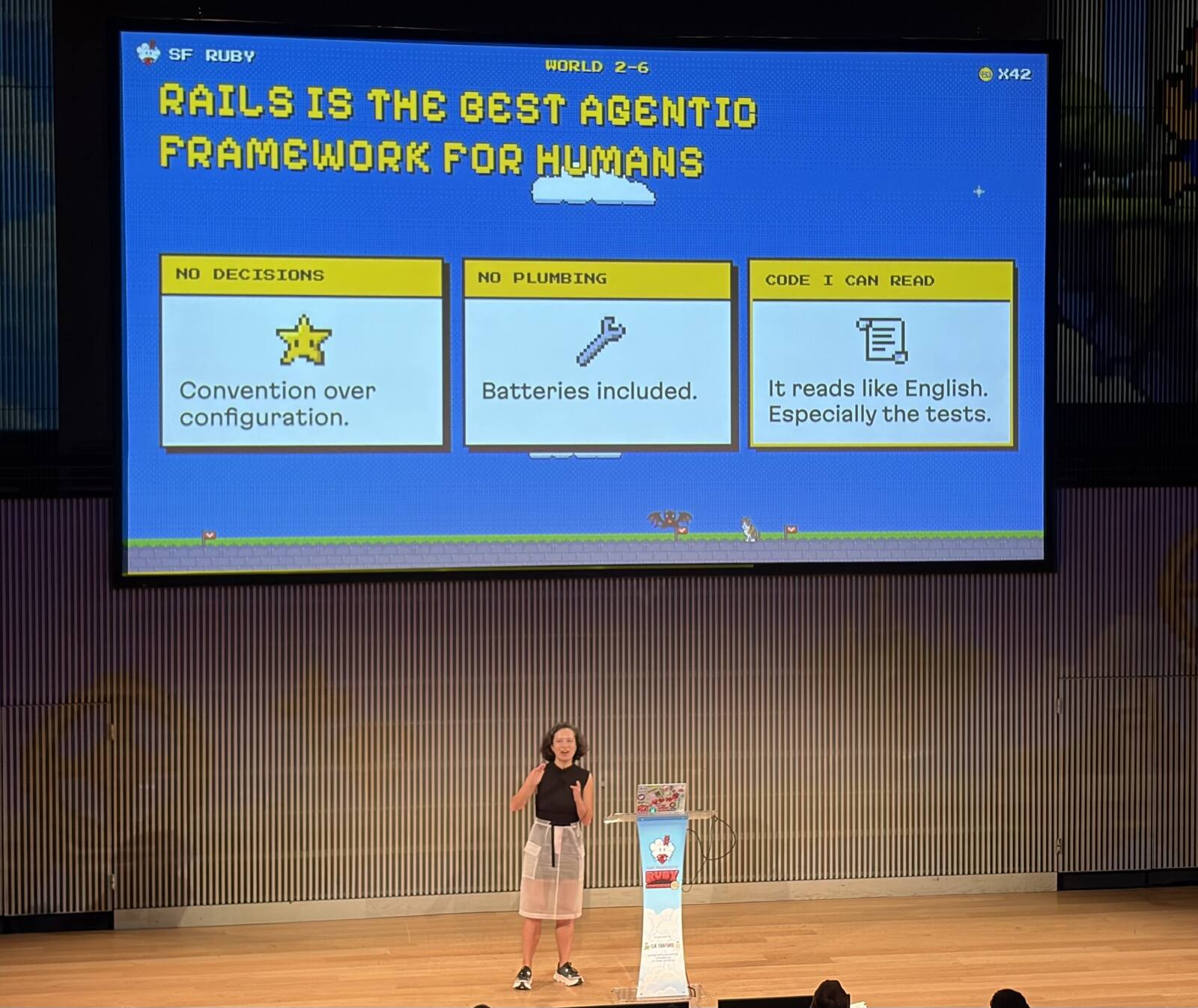
Irina summed up the founders’ answers in one slide: Rails is the best agentic framework for humans.
A few founders also pointed out that Ruby people love Ruby people.
The community might be smaller, but once you find it, hiring and building a team gets easier because people know each other.
What’s missing (and who’s already building it)
This was my favorite part of the talk. Irina listed what founders say is missing, and for almost every item she had someone in the community already working on it. The exception was types: Irina’s take was that on every public benchmark so far, static types don’t help agents, and she asked for a benchmark that shows otherwise before changing her mind.
UI Components
Rails has component systems, but not yet the kind of library that wins over designers and design engineers.
Marco Roth is working on components built on Herb , and Matt Solt recently showed Poetry UI .
Irina’s ask was to be more ambitious: think Figma to Herb components.
Hotwire Documentation
Founders love the calm that Hotwire brought to the frontend, but the documentation has been thin since 2021.
Irina mentioned an official Rails guide in review, and it was merged into the edge guides on November 10 , the day the conference opened.
I/O Concurrency for AI workloads
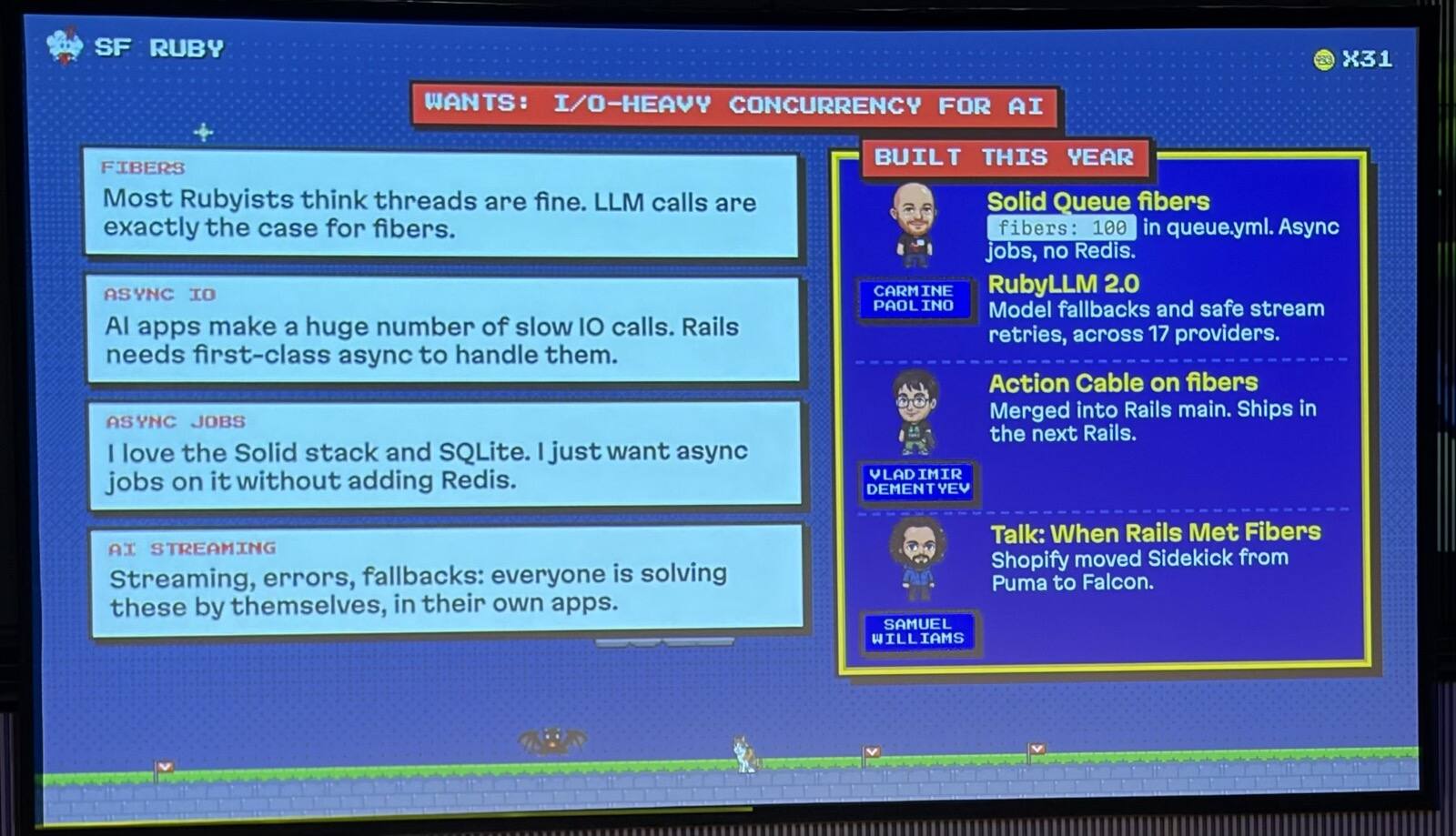
AI apps make a huge number of slow I/O calls, and LLM calls are exactly the case for fibers.
Carmine Paolino added fiber support to Solid Queue, so you get async jobs without adding Redis. Vladimir Dementyev’s Action Cable on fibers was merged into Rails main and ships in the next Rails.
Samuel Williams, the author of Falcon, gave a talk at Deccan Queen on Rails 2026 about Shopify migrating Sidekick from Puma to Falcon. The recording is worth your time:
Memory
Rails apps still use more RAM than founders would like. There is no single answer yet, but there are experiments: Kino , a Ractor-based web server for Ruby 4, and AnyCable moving WebSocket connections out of the Ruby process.
In the meantime, there is a lot you can do about memory in the app you already have. We’ve written about using Bumbler to trim runtime dependencies , finding gems that leak memory with bundler-leak , and the common culprits behind Rails performance issues .
LLM Tracing
Founders asked for first-party SDKs. OpenTelemetry already works, and Istvan Hoka’s sentry-agents gem adds
out-of-the-box RubyLLM instrumentation to Sentry.
Safe Production Access for AI Agents
Nobody wants an agent pasting snippets into a production console.
bin/rails query gives read-only database access with
structured JSON output, and it was merged in April.
Three years of founder feedback, and the community has an answer in progress for almost every item. That is a huge testament to the people in this room.
Understand the present before building the future
Irina’s guidance for the turbulence we’re in was refreshingly practical.
Our main job right now is not to predict the distant future. It is to understand what is actually happening today: what works, for whom, and how.
That means learning the recipes from teams big and small, but also learning how to evaluate whether a new tool or skill works for you.
Irina sketched three kinds of engineers she sees emerging on AI-era teams: the product engineer who asks why, the high-risk engineer who owns payments, billing, and security, and the agentic platform engineer who owns the agents’ environment.
The High-risk Engineer
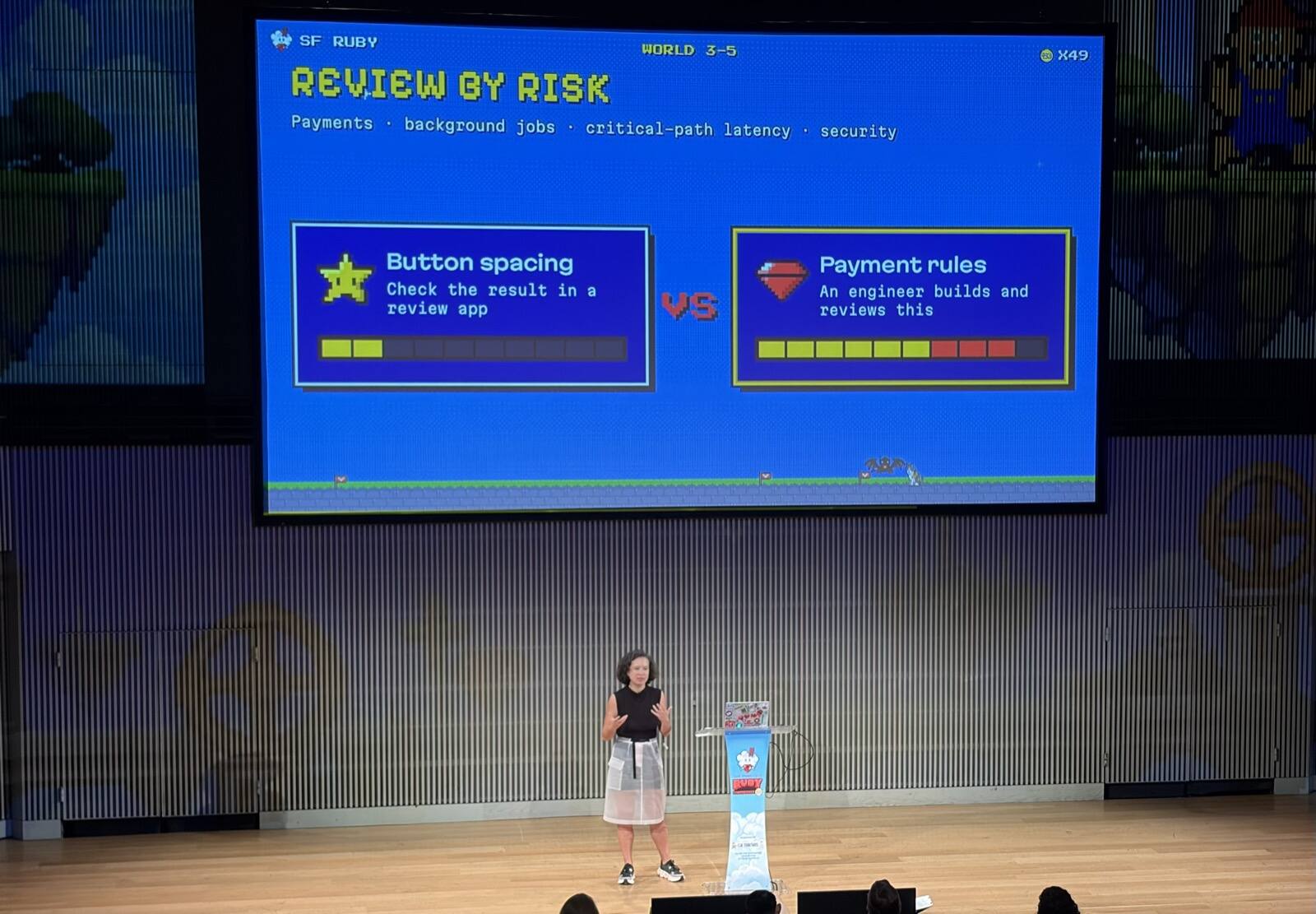
The high-risk engineer reviews by risk, not by complexity. A button spacing change gets checked in a review app. A change to payment rules gets built and reviewed by a human engineer.
The Agentic Platform Engineer
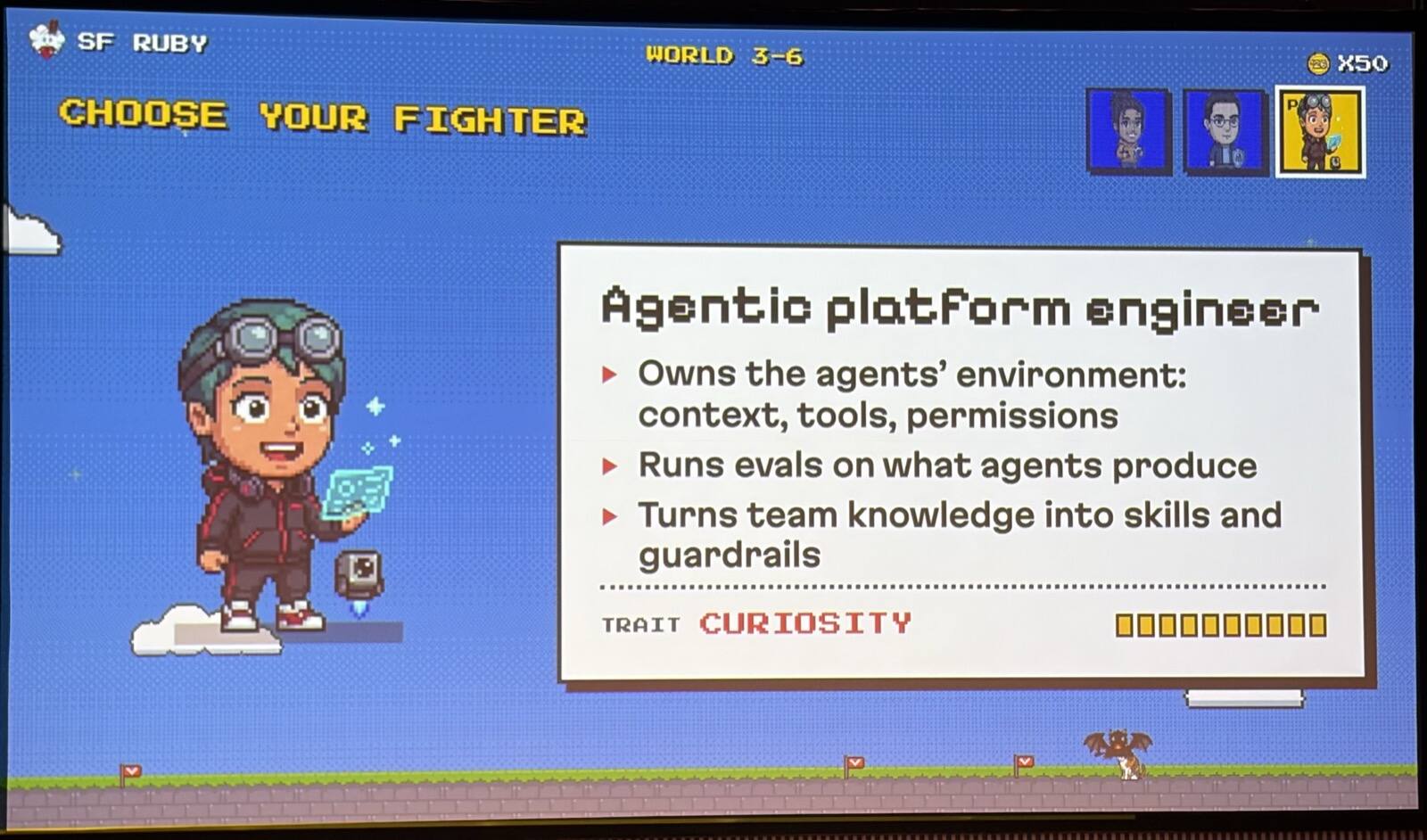
The agentic platform engineer is the role I expect to see a lot more of.
They own the agents’ context, tools, and permissions, run evals on what the agents produce, and turn team knowledge into skills and guardrails.
Good engineers have always read code before pasting it, and the same discipline applies to AI workflows.
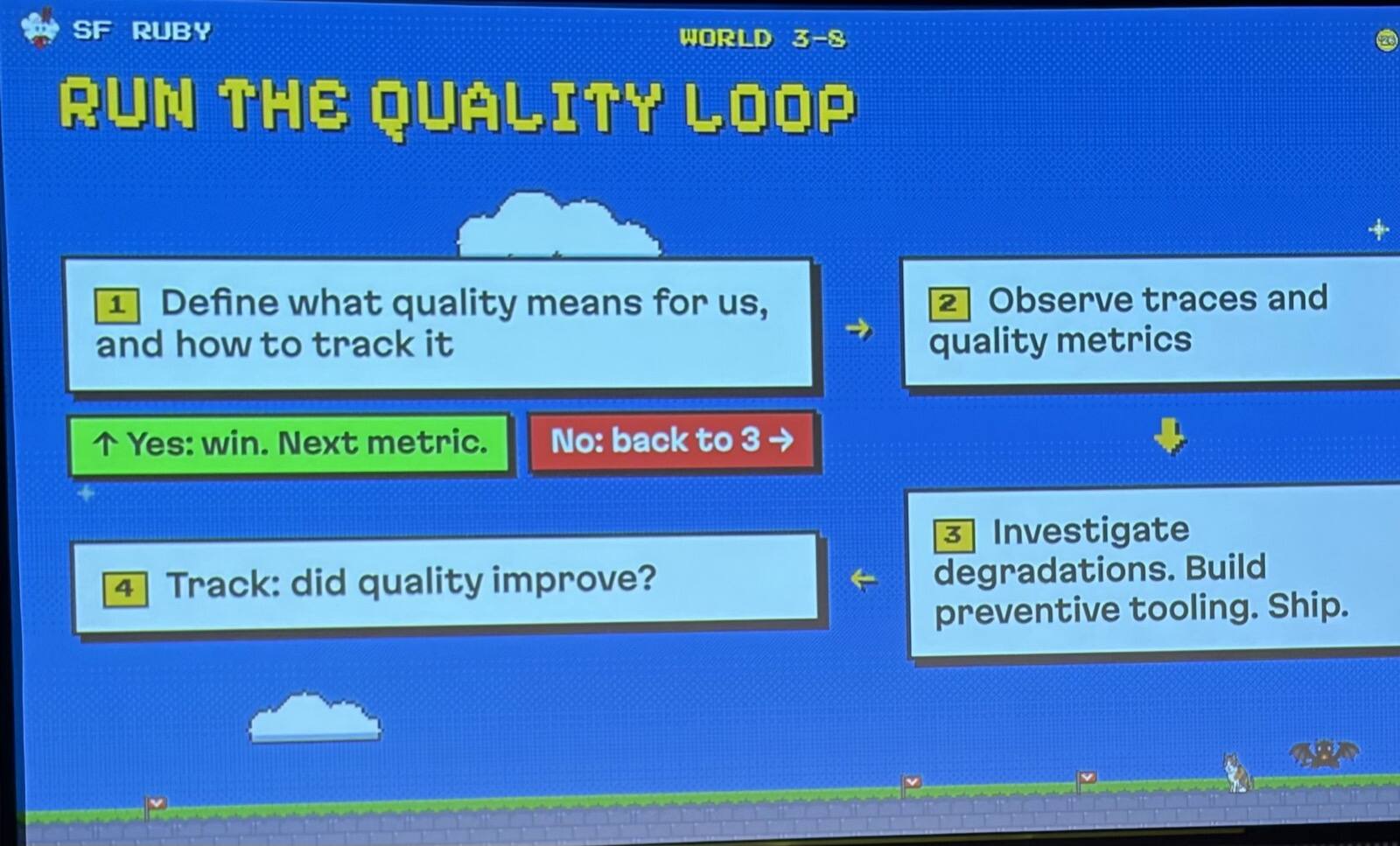
Irina calls it the quality loop: define what quality means for you and how to track it, observe traces and quality metrics, investigate degradations and build preventive tooling, then ship and check whether quality improved.
The good news is that the “build preventive tooling” step doesn’t have to start from scratch. The Ruby community has had code quality guardrails for years, and they work just as well on code an agent wrote as on code a human wrote.
I’m a proud co-maintainer of RubyCritic and Skunk , which combine complexity, code smells, and test coverage into a score you can track over time.
Add them to the other code quality gems and the open source tools we use for Rails upgrades , and you have a quality loop that runs on every pull request.
I strongly encourage our customers to set these guardrails up before they turn agents loose on their codebase. If quality drops, you want to know in CI, not in production, or 6 months later during a major outage.
Irina also shared results from a set of agent evals run in October 2026 against Rails apps like Redmine, Forem, and Mastodon.
The pattern was clear: agents fail when they hand-roll what the framework already solved.
- Agents that reached for Action Cable for live updates passed. Agents that hand-rolled polling flooded the servers.
- Only the agents that reused the app’s existing private-network guard blocked SSRF addresses.
- Four out of four agents hand-wrote a migration instead of using the generator, and three of them made it irreversible.
This is exactly why conventions are a gift to the models.
It’s also why I keep saying someone on your team needs to understand the framework. The agent doesn’t know your migration is irreversible until a human who knows Rails looks at it.
Rails 8.2 is almost here
In my Rails World post I said that a lot of the future of Rails was being built in the other talks, not the opening keynote.
Two months later, Rails 8.2 still hasn’t shipped as I write this, but the release notes are shaping up to be a big deal in three areas.
Frontend
Herb was merged into Rails core , so Rails 8.2 can compile your .html.erb templates with an HTML-aware parser.
ReActionView builds reactive templates on top of that, Lexxy gives ActionText a modern editor, and the Hotwire guide finally gives the frontend stack official documentation.
Security
New 8.2 apps get header-based CSRF protection using the Sec-Fetch-Site header by default, so same-origin requests no longer need authenticity tokens.
has_secure_password gains built-in Argon2 support, which drops bcrypt’s 72-byte password limit. Rails.app.creds unifies access to credentials from ENV and the encrypted
credentials file. Active Storage now analyzes attachments before validation, and once 8.2 ships, the Hot Cell gems
can sandbox image processing.
Performance
ActiveSupport::Ractors is in, the first step toward running Rails under Ractors . Shopify’s experiment with
Writebook showed a pool of 8 Ractors using nearly 7x less memory than 8 forked Puma workers.
Active Job now enqueues after the transaction commits by default, and parallel tests get work stealing so idle workers pick up the slack.
That is a lot of attention on the view layer, on security defaults, and on the memory problem founders keep bringing up. It’s the future of Rails I was hoping to hear about in Austin.
Welcoming the next person
The part of the talk I didn’t expect was about who gets to build with Rails next.
Irina’s observation is that every non-technical person in a tech organization is now looking at charts of GitHub commits and wondering if they could build something themselves.
Rails is well positioned for that. A product manager with a coding agent and a framework full of conventions can build tools for themselves, their team, or their product.
What’s missing is the tooling and the safe boundaries to let them contribute without breaking production. Read-only access like bin/rails query is part of that answer.
SF Ruby closed with a Rails Girls event on November 12, and Irina’s ask to the room was “Invite a teammate. Come mentor.” The conference also listed 119 open positions at 56 Ruby companies, 8 of them entry-level.
That is what an ecosystem with its best years ahead of it looks like.
Conclusion
Irina’s keynote in San Francisco was inspiring because it was about Rails, and about the founders, maintainers, and newcomers building on it.
Both Garry and Irina agree on the core idea: Rails conventions are a gift to the models.
Irina’s talk showed all of us the other half, that the community is actively closing the gaps founders run into, and that the next Rails release is going to make the framework faster, safer, and better on the frontend.
I’m excited about the future of Rails in this agentic era. I’m excited to keep building. ❤️
Are you figuring out how AI agents, Rails 8.2, and Ruby 4 fit into your application’s roadmap? Let’s talk!